
Acculturation, Trauma, and Music
by
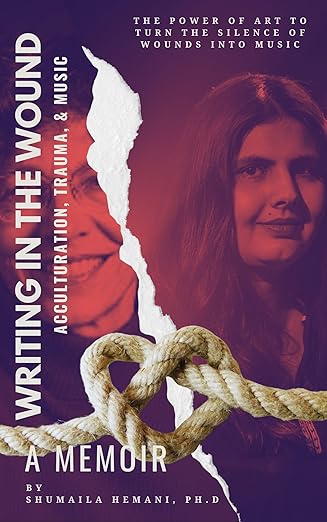

What happens when your scars begin to speak?
For Dr. Shumaila Hemani, music began as a calling. It unfolded into a life path through a rare human connection — with eminent ethnomusicologist Prof. Regula Burckhardt Qureshi — whose faith in her awakened the courage to risk everything for the artist’s path.
Spanning nearly two decades, from 2006 to the present, across the academic corridors of Harvard and the University of Alberta to the soundscapes of London, Boston, Chicago, Edmonton, Mumbai, Karachi, Calgary, Banff, and Toronto — and a world odyssey aboard a floating campus — Writing in the Wound is a story of resilience and fragile belonging, of visibility and erasure, and of the power of art — in particular, Sufi music — to transmute pain into wisdom while risking truth and vulnerability in the face of institutional silencing, immigration precarity, and the long endurance toward permanent belonging.
"This book emerges from seventeen years of living with immigration precarity in Canada while following my calling. It risks truth and vulnerability in the face of institutional silencing, systemic erasure, and the long endurance toward permanent belonging."
Some wounds don’t go away. They resurface and spiral through different points in life—silent reminders of lessons still waiting to be understood. They twist into the body like questions without answers, returning not to punish but to reveal what is still alive inside.
And when forgotten wounds haunt your nightmares—waking you in the middle of the night, not only as pain but as messengers—they demand attention. They are not just echoes of suffering. They are warnings. Invitations. Scarred whispers urging you to pause, to listen, to take them seriously.
Because sometimes the wound that reopens isn’t punishing you—it’s protecting you from walking into fire again.
Even as I reclaimed my voice and began to recognize the wound as teacher, another layer surfaced—one I hadn’t named. It didn’t speak in migraines. It arrived in recurring dreams.
Night after night, I was trapped in violent dreamscapes—visions of being chased, violated, overpowered.
They weren’t literal memories. But they carried the emotional truth of a lifetime of precarity: moving through the world as a woman with no institutional protection, no safety net, no permanent belonging.
The dreams terrified me. But they whispered what my waking mind wasn’t ready to admit: the field—the place where I had once gone to listen and document—no longer felt safe. Not for my body. Not for my soul.
That was when I started really listening—unconventionally—to the intelligence within me that said: Your scars are speaking. Something is off.
Listening to those scars would change everything—how I moved, how I chose, and how I began to draw the boundaries that would save me.
on Literary Titan:“This fascinating memoir covers Hemani’s journey through three continents, her studies as an ethnomusicologist (way more interesting than you might think!), her growth and multiple awards as a Sufi poet and musician, and 17 years of being denied permanent residency by the Canadian government.”
"Writing in the Wound is a memoir about what it means to be shaped and repeatedly injured by migration, academia, gendered power, and the long bureaucratic violence of immigration precarity, while still refusing to let art go mute. Author Shumaila Hemani traces that struggle across Karachi, London, Edmonton, Harvard, Banff, Calgary, and beyond, returning again and again to music as both discipline and rescue. What stayed with me most was the book’s insistence that the “wound” is not just a private sorrow but a structural fact, something lived in the body and sharpened by institutions, and that song can become not a cure exactly, but a way of bearing truth without surrendering to it. Scenes like the freezing Alberta night when she seeks refuge in a restaurant lobby, her charged decision between Chicago and Harvard, and the later episodes of artistic endurance under precarity give the memoir a real narrative pulse beneath its reflective surface.
What I admired most was the book’s emotional candor and the seriousness with which it treats art. Hemani writes as if sound were breath, shelter, lineage, prayer, argument, and last defense all at once. I found that deeply moving. Some of the strongest passages are the ones where sensory memory and intellectual reflection fuse cleanly: Karachi’s street sounds and household textures, the strange thrill of hearing the theremin in London, the feeling of Cambridge as a place that “held” her differently, the sea storms aboard the World Odyssey, the pink-moon stillness that arrives after so much psychic abrasion. The prose can be overtly lyrical, but for me, that ambition is mostly earned because it rises from lived intensity rather than decorative flourish.
Its ideas are forceful and, at their best, unsettling. Hemani’s central claim that exclusion is often discussed in abstract policy language while its damage is absorbed by actual bodies felt painfully persuasive. The memoir is strongest when it shows that argument rather than merely stating it: in the humiliations of school and class performance, in the uneasy academic encounters where she feels reduced to a gap to be filled rather than a mind to be met, in the grinding absurdity of years of achievement that still do not translate into belonging. There were moments when I wanted a bit more compression, because the book sometimes circles its pain. But even that repetition began to make sense to me as part of the memoir’s design. Trauma here is not tidy, and Hemani refuses to fake tidiness for the reader’s comfort. I respected that.
I found Writing in the Wound arresting, thought-provoking, and fiercely alive. It’s a memoir that believes art can carry knowledge that institutions cannot properly hear, and that belief gives the whole book its tensile strength. It keeps faith with fracture while still making room for beauty, devotion, and survival. I’d recommend it especially to readers drawn to memoirs of migration, music, trauma, and intellectual becoming, and to anyone interested in how a life in art can be both exalted and terribly precarious."