

A Historical Novel
by
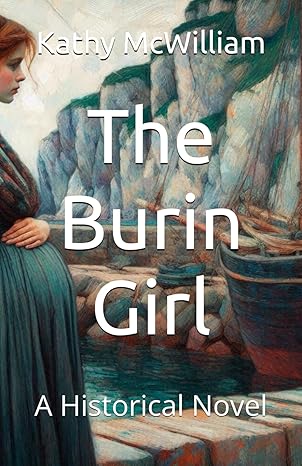



The Burin Girl is the fictional story of Johanna O’Shea, a Newfoundland outport girl who grows up on the southern coast of the Burin Peninsula at the turn of the twentieth century. She truly comes of age in the crucible of widowed poverty in the city of St. John’s during the Depression.
Johanna is the core around which the novel revolves, but the story of her life resounds with the affection, humour and cheeky conversations of the minor and major characters who flesh it out. Her love affairs, however improbable, make perfect sense because she is who she is. She raises a crop of resilient (an overused modern word Johanna would have had little use for), strong-willed and irreverent youngsters. She tells her children to take whatever they need without apology: survival is the game. In the end, that philosophy explains her, and in the end, her children understand her choices.
Me and Henry, we had our little boy. Two months only, we had him for. And then God shook him to death, took him away. The poor little babe, so helpless and small, burnin’ up with the fever, he was. Mam came too late. Her witch’s ways, I wonders, would they have saved him?
Then Henry walks heavy downhill to the wharf, climbs aboard his skiff and points it out to sea. He asks his questions to the sky, out there on the water, and toils out his sorrow ‘gainst the wind. I gots no where to ask – Reverend Father tells me nothin’ I can swallow down whole. I wants to believe there’s reason for all that befalls us poor sinners. Our babe weren’t no sinner. But weren’t he grand while he were here? The loveliness of him - little warm bundle of life. We searched his tiny face and asked, “Now who do he look like?” I said ‘Henry’ and Henry said ‘You’. We thought he was like me for length of limb, and Henry for width of chest.
We pictured his life, we did, told him what would be, by the stove those few evenin’s of his life. And now he’s gone.
COLLAPSESuzan Stevenson on Reviewed in Canada on April 22, 2026 wrote:5*
"Women at Work
In her fine new novel, The Burin Girl, author Kathy McWilliam delivers a narrative that digs deep into the daily life of a working-class woman, Johanna O’Shea. Johanna comes to
Newfoundland and the O’Shea household to wed widower Henry O’Shea, who has been left with children and does not have the time to tend to them. He really needs to be manning a fishing boat to earn his pay, so Johanna arrives, eventually marries him, runs the household, and looks after the children.
Johanna arrives shortly after the turn of the 20th century, in 1909. Her mother hears a stranger say that a widower needs help, so she inquires: “Tell us, now, about the poor man so desperate that Johanna should go to Burin?” Henry is apparently on his own with no one to see to the “little souls.” Johanna arrives, they eventually marry, and she learns straight away that chores don’t end after the kids are fed and the kitchen is clean. It is made abundantly clear that many women, just like Johanna, had few options open to them economically speaking, and hence sex becomes just another duty for Johanna, and she is none too happy with it.
However, Johanna doesn’t complain; she accepts her lot in life and approaches sex as she does any other task: I wish Mam had told me what I does next. In there. In that room, the one with the bed in it. The him smell that I know well, all pipesmoke and man-smell together, fish-smelly socks just off his feet…
No, sex is labor, nothing else, and the result is more labor, in the form of pregnancy. McWilliam makes it crystal clear that life in this cold new frontier is harsh, and not all of Johanna’s kids make it. Pregnancy is tough, and the book really drives this point home.
What The Burin Girl really does is explore how women use their ingenuity to create a sort of solidarity. The connection between mothers and daughters and other female friends is a vital part of life for women living in this era. They come to understand the world by educating themselves and sharing through the oral tradition. It has been women, throughout the centuries, who have identified which foods are edible and which will kill you, when to plant certain vegetables, how to make clothing, and most importantly, how to use plants as medicine.
There is a poignant moment after Johanna loses her second son, who dies at just two months old. She thinks of her mom and asks herself, “Her witch’s ways, I wonders, would they have saved him?”
The working-class vernacular is spot-on, and again, the main theme is driven home: women need to work together, educate themselves, and forge a solidarity that makes it able for them to exist in an especially tough climate (at a time when most homes probably had no electricity). The Burin Girl shows us, at nearly every juncture, that the patriarchy and its system offer little support for women like Johanna. Even the Reverend Father at church speaks in platitudes, leaving Johanna feeling like she has nowhere to turn: “Reverend Father tells me nothin’ I can swallow down whole.”
The truth here is not pretty. But The Burin Girl shows us how to survive when the odds are stacked against you, and by exploring the plight of working women in a turn-of-the-century
Newfoundland fishing village, we see a world that is in some ways similar to that of Céline Sciamma’s brilliant film, Portrait of a Lady on Fire. Both are important works that highlight the reality of living in a patriarchal society, and somehow, finding in solidarity a means of making it all work. The Burin Girl does exactly that."
5 out of 5 stars
"Loved it
"Well paced, very immersive story that held my attention from start to finish."