
Acculturation, Trauma, and Music
by
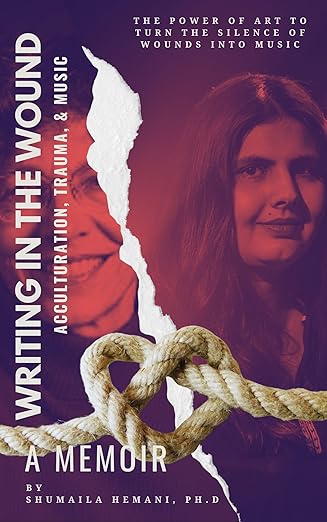

What happens when your scars begin to speak?
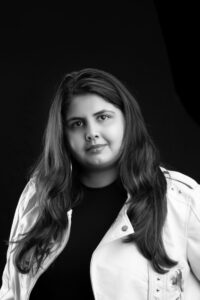
For Dr. Shumaila Hemani, music began as a calling. It unfolded into a life path through a rare human connection — with eminent ethnomusicologist Prof. Regula Burckhardt Qureshi — whose faith in her awakened the courage to risk everything for the artist’s path.
Spanning nearly two decades, from 2006 to the present, across the academic corridors of Harvard and the University of Alberta to the soundscapes of London, Boston, Chicago, Edmonton, Mumbai, Karachi, Calgary, Banff, and Toronto — and a world odyssey aboard a floating campus — Writing in the Wound is a story of resilience and fragile belonging, of visibility and erasure, and of the power of art — in particular, Sufi music — to transmute pain into wisdom while risking truth and vulnerability in the face of institutional silencing, immigration precarity, and the long endurance toward permanent belonging.
"This book emerges from seventeen years of living with immigration precarity in Canada while following my calling. It risks truth and vulnerability in the face of institutional silencing, systemic erasure, and the long endurance toward permanent belonging."
Some wounds don’t go away. They resurface and spiral through different points in life—silent reminders of lessons still waiting to be understood. They twist into the body like questions without answers, returning not to punish but to reveal what is still alive inside.
And when forgotten wounds haunt your nightmares—waking you in the middle of the night, not only as pain but as messengers—they demand attention. They are not just echoes of suffering. They are warnings. Invitations. Scarred whispers urging you to pause, to listen, to take them seriously.
Because sometimes the wound that reopens isn’t punishing you—it’s protecting you from walking into fire again.
Even as I reclaimed my voice and began to recognize the wound as teacher, another layer surfaced—one I hadn’t named. It didn’t speak in migraines. It arrived in recurring dreams.
Night after night, I was trapped in violent dreamscapes—visions of being chased, violated, overpowered.
They weren’t literal memories. But they carried the emotional truth of a lifetime of precarity: moving through the world as a woman with no institutional protection, no safety net, no permanent belonging.
The dreams terrified me. But they whispered what my waking mind wasn’t ready to admit: the field—the place where I had once gone to listen and document—no longer felt safe. Not for my body. Not for my soul.
That was when I started really listening—unconventionally—to the intelligence within me that said: Your scars are speaking. Something is off.
Listening to those scars would change everything—how I moved, how I chose, and how I began to draw the boundaries that would save me.